Draws the AASHTO intersection sight triangles for a minor approach onto a major road from one pick: departure sight distances from design speed × time gap, legs running up- and down-station along the alignment, then flags anything on the obstruction layers standing inside a triangle.
Road edges / approach
Major-road alignment + driver's eye
Sight triangle
C-ANNO-SGHT / obstruction ERROR
Clear (outside)
What it does
- Pick topology: select the major-road alignment + the intersection point; the pick's side of centerline places the driver's eye.
- Departure ISD:
ISD = 1.47 × V × t_g, rounded up to 5 ft (25 mph → 280 ft left / 240 ft right). - Legs along station: run up- and down-station along the alignment, so a curved major road bends the sight line with it.
- Apex: sits at the driver's-eye offset from centerline (default 20 ft).
- Obstruction check: entities on the obstruction layers whose extents fall inside a triangle flag as ERRORs (extents-based, conservative).
- Triangles +
ISD 280 FTlabels are XData-stamped; Clear removes exactly ours.
Settings & options
- Design speed: 20–60 combo, any value typable.
- Time gaps: left-turn
7.5 s, right/crossing6.5 s; add 0.5 s per extra crossed lane. - Driver's-eye offset: apex distance from centerline (default 20 ft).
- Obstruction layers: wildcards
*BLDG* *TREE* *LSCP* *SIGN* *WALL*, editable insettings.json. - Triangle layer default
C-ANNO-SGHT(red); check toggle in the dialog. - Persisted at
%APPDATA%\VDC\SightDist\settings.json(envVDC_SIGHTDIST_SETTINGS). Vertical/crest sight distance isVDCROADQC's K-value territory.
Dialog
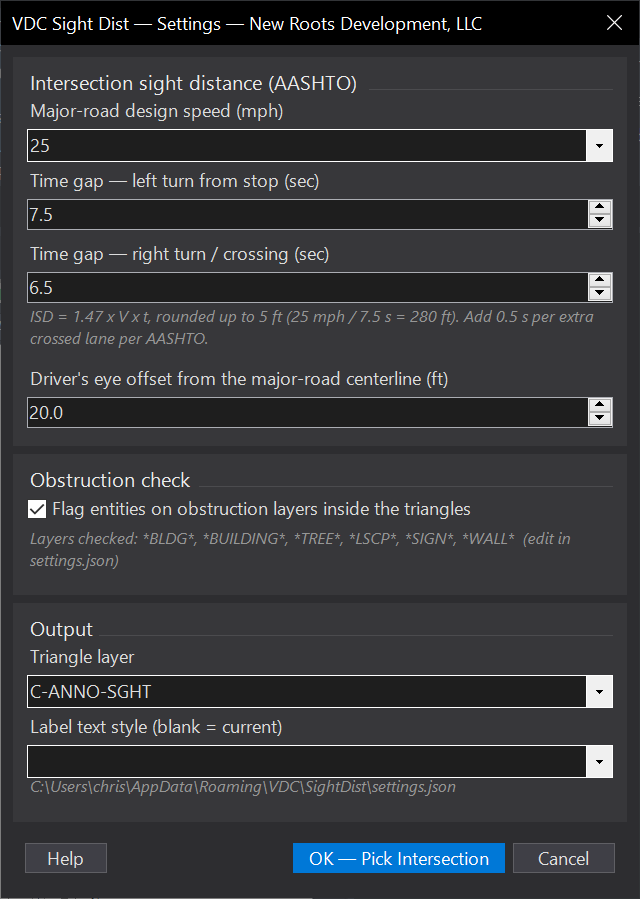
VDCSIGHTDISTWhen to use it
- Every driveway / street connection exhibit - one pick instead of construction lines.
- Checking a proposed monument sign, landscaping berm, or wall against the sight triangle before it's built.
How to run it
- Run VDCSIGHTDIST - pick Run in the mode dialog; set the design speed, time gaps, and eye offset; click OK.
- Select the MAJOR road alignment, then pick the intersection point (your pick's side of centerline places the driver's eye).
- Both departure triangles draw with ISD labels; anything on the obstruction layers inside one flags to the palette.
- Repeat per approach; Clear mode removes all triangles.
Options
- Design speed / time gaps: left turn from stop 7.5 s, right/crossing 6.5 s (AASHTO passenger car); add 0.5 s per extra crossed lane.
- Driver's eye offset: apex distance from the major-road centerline (default 20 ft).
- Obstruction layers: wildcards (default *BLDG*, *TREE*, *LSCP*, *SIGN*, *WALL*); edit in settings.json.
Watch out for
- This is the HORIZONTAL check - vertical sight distance over crest curves is Road QC's K-value territory.
- The obstruction test is extents-based and conservative: a hedge reads as its bounding box.
- An ISD leg past the alignment's end draws what fits and flags a WARNING - carry the check onto the adjoining alignment by hand.
Related: Road QC · ADA Slope Audit · Fire Coverage