Checks every plan-view crossing between pipe networks for adequate vertical clearance: outer-wall-to-outer-wall gaps that are negative are conflicts (ERROR); gaps below the required discipline-pair separation are separation shortfalls (WARNING).
Crossing pipe (in section)
Crossing pipe (cross-section)
Conflict (negative gap)
Separation shortfall
Pass
What it does, per run
- Snapshot: reads every gravity pipe (storm/sewer) and pressure pipe (water/force-main) with its centerline and outer diameter.
- Classify: each pipe tagged to a discipline by network-name substring; unmatched networks use the default rule.
- Crossings: for each pair from different networks, finds the 2D plan intersection and interpolates each pipe's Z there.
- Gap: computes outer-wall-to-outer-wall vertical clearance vs the discipline-pair rule.
- Conflict = negative gap (walls overlap, ERROR); Separation = positive but below rule (WARNING).
Settings & options
- Default separation: clearance when no pair rule applies (default
1.0 ft). - Skip same-network crossings: on by default, pipes within one network connect at structures; toggle off to include.
- Discipline-pair rules: water÷sewer, water÷storm, water÷force-main
1.5 ft; sewer÷storm, sewer÷force-main1.0 ft. - Prefix lists classify pipes into disciplines; report cap and rules edited in
settings.json. - Settings at
%APPDATA%\VDC\Clash\settings.json(VDC_CLASH_SETTINGS), schema-tolerant load. - Pressure pipes sampled by endpoints, a curved main is treated as straight for the test.
Dialog
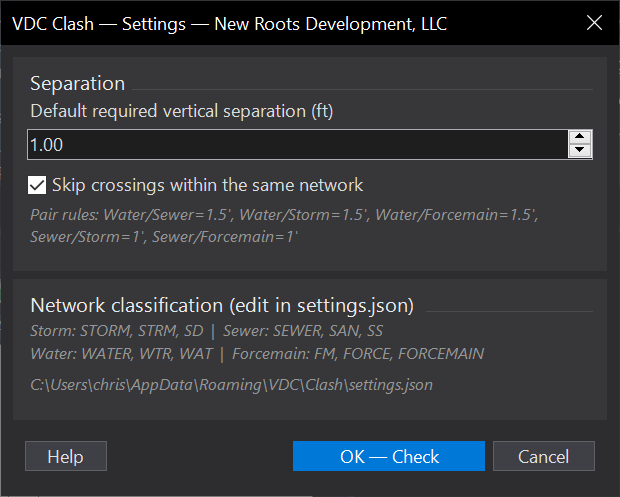
VDCCLASHWhen to use it
- Coordinating utility crossings - finding hard conflicts and separation shortfalls before plan production.
How to run it
- Run VDCCLASH; set the default required vertical separation and whether to skip same-network crossings.
- Click OK; the tool reads every pipe, classifies it by network name (storm / sewer / water / force-main), and tests each crossing.
- Review ERROR conflicts and WARNING shortfalls in the palette; double-click to zoom.
Options
- Default separation: vertical clearance used when no discipline-pair rule applies (default 1.0 ft).
- Skip same-network crossings: on by default - pipes within one network are not compared.
- Discipline-pair rules: water-to-sewer / storm / force-main 1.5 ft, sewer-to-storm / force-main 1.0 ft (edited in settings.json).
Watch out for
- Gap is computed from pipe outer diameters - overlapping walls (negative gap) are physical conflicts.
- Crossing detection is 2D plan view; Z is sampled along each centerline at the crossing point.
- Discipline is classified by network-name substring - a network not matching any prefix uses the default separation.
Related: Pipe QC · Pipe Crossings · Easement Widths