AI assistantsReview assistants
A team of AI reviewers that check complex document packages the way a senior reviewer would, against the actual written rules of the agency that has to approve them, and write the report a person then approves.
- Six specialties, each with its own checklist and report, including a general checker for the notes, the sheets agreeing with each other, and the math
- More than 200 agency rule profiles across South Carolina, North Carolina and California, every rule tagged with its source, and nothing unverified on the list we show
- Reads a marked-up set the way the county returns it, checks whether each answer actually holds up on the drawings, and drafts the next response with anything unverified flagged
- On one 49-sheet set, the same 0.52 ft error on 16 structures showed that two versions of one pipe network had ended up in the package
- Set up for a new team in steps: the method, the public agency rules, then the team's own standards, checked against two or three past jobs before anyone relies on it
Why it matters to any business: anyone who checks documents against rules, from contracts to insurance forms to compliance checklists, can have the same thing built around their own rules.
ApplicationSite Snapshot
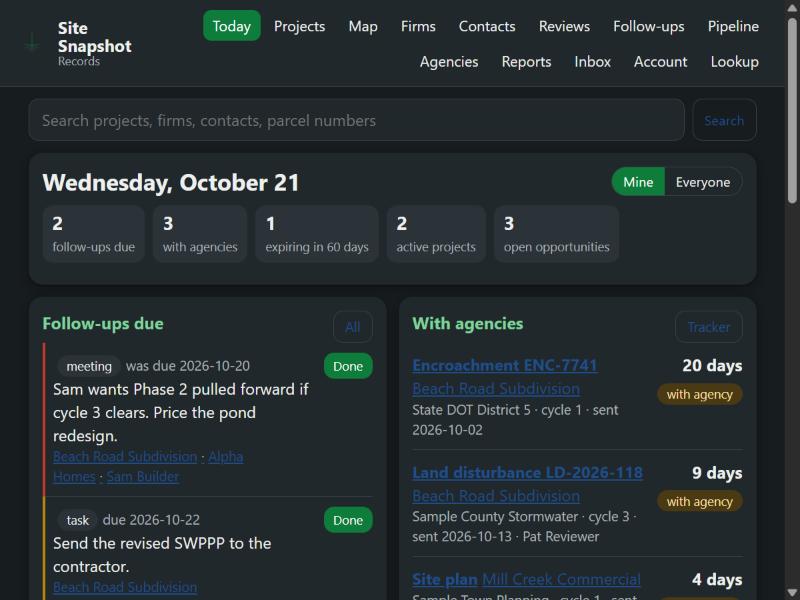
Type an address or drop a pin and get one page with what the public record says about that property: jurisdiction, parcel, flood zone, soils, terrain, watershed, nearby roads and utilities, and the permitting path a project will follow.
- Pulls from many public data sources at once and lays them out on a phone
- Sign in and the same page becomes the project record: permits, review cycles, contacts and each agency's real turnaround
- Files an email to the project record from the inbox, and prints a one-page site report with an aerial photo, the parcel outline and every source dated
- Built as an installable web app, no app store needed
ApplicationStakeTally
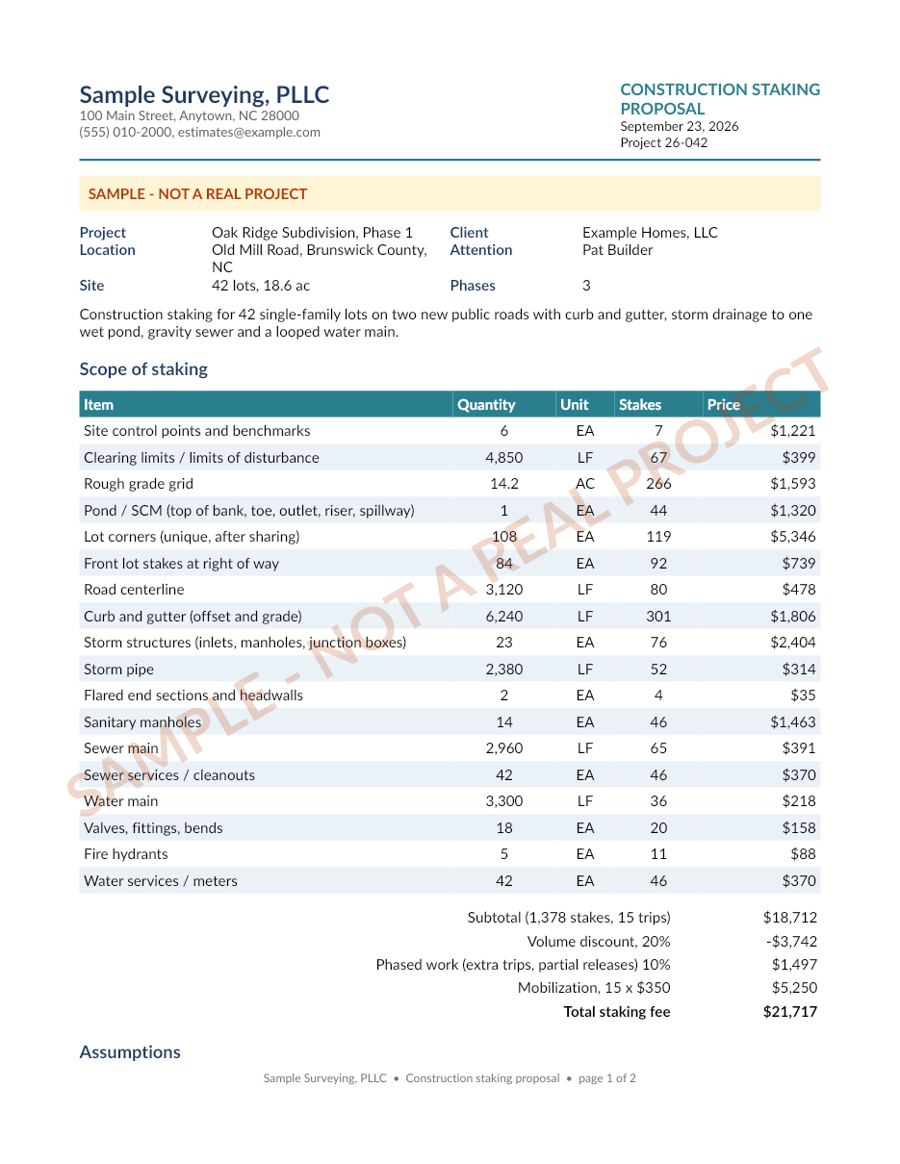
An estimating application for field and drone work. Drop the project documents in and the priced proposal comes out, with the math shown.
- Uses AI to read the documents, including scanned pages, and match every item to a price catalog
- Plans the drone flight from a boundary and an accuracy target, and prices that too
- Writes a proposal PDF, an Excel workbook and a CSV in one click
- Twelve release builds, each shipped with its own user manual
AutomationOvernight watchdogs and weekly reports
Scheduled routines that do the checking nobody has time for, run while the office is empty, and change nothing unless a person says so.
- A read-only scan of an entire file server that found project files quietly bloated with millions of hidden objects
- A naming standards audit across every project folder, and a report of every new file that appeared
- A weekly backlog report that compares two sets of dates and lands every Monday, change or no change
- A duplicate scan of about 200,000 files that matched copies by content and moved them aside instead of deleting anything
The rule we build by: automations read first and write only with permission. Every scan proves it changed nothing before it reports.
Documents and dataPaperwork that fills itself out
The forms and spreadsheets every business drowns in, rebuilt so the data goes in once.
- A state permit package combined into one self-checking workbook: 208 application fields mapped, and one button writes every PDF and fills the agency's own electronic forms in about 22 seconds
- 469 pay items mapped to past bid prices, so a quantity takeoff can price itself
- Quantity summaries pulled from the source data into a branded, print-ready spreadsheet
- New contracts turned into task lists automatically
- Published procedures and manuals locked so only the owner can edit them
Typical result: one set of inputs, the checks done by the file instead of by memory, and the output already formatted the way the agency or client wants it.
Custom toolsAdd-ons for professional software
A full suite of custom commands added to professional desktop software, built to one organization's standards and running across its whole office.
- Organized on their own toolbar tabs, with a search box that marks new tools, added because people could not find them
- Standards checks driven by editable rule files, so the rules change without new code
- One codebase that serves four yearly versions of the host program, deployed in one run
- Public soils, wetlands, terrain and survey control data pulled straight into the drawing and clipped to the site
- Release notes built into the product, so nobody wonders what changed
Not for sale. Tools like these are built only as part of a consulting engagement, for that client's standards.
CommunicationMessages, uploads and publishing
The small systems that keep information moving between people.
- A send tool built into desktop software, with a private upload link for files too big for email that clears itself after 90 days
- Release notes turned into social posts and a newsletter, held for approval before anything publishes
- A morning reminder with the day's post, picture and link ready to go
- This website, updated by asking, with automatic checks that refuse to publish a wrong price or phone number
Approval gates everywhere: nothing we build sends, posts or publishes in your name without a person saying yes, unless you decide later to loosen it.
Drone captureDrone imagery to 3D
Imagery flown, processed into a point cloud, and turned into a 3D surface that can be measured.
- Stockpiles, earthwork volumes, progress capture and property documentation
- Drone lidar files opened and tested before anything is promised, which is how we found why a whole class of them would not work with standard tools
- Thinned test data cut from very large lidar datasets, so tools are tested on real files
Plainly stated: our own aircraft collects imagery, not lidar, and we say so before any job is priced.
AI assistantsA library of assistants that know the rules
Custom AI assistants, each one trained on one organization's own standards, checklists and history, and used every day.
- A dozen specialist assistants, from reviewers to a support desk that answers how-to questions from the organization's own standards
- Comment letters from 15 past projects read and sorted, so the assistant knows what each agency actually asks for
- Every real comment from an outside reviewer becomes a rule the assistant checks next time
- Rule changes are written down and versioned, so anyone can see what the assistant was told and when
- Every AI run logs what it cost, so the bill is never a surprise
What a client gets: assistants that answer the way your best person would, from your rules, not from the internet.
MethodHow we build with AI
AI does the heavy lifting on everything on this page, and these habits are what keep its work honest.
- Several AI builders working at once, each on its own branch from a written spec, with one integrator merging their work: ten new tools in one round
- More than 3,800 automated tests, then a run in the real program on a full-size test file, with pictures of every step
- Every installer tested on a clean machine before anyone else runs it
- Every correction the owner gives the AI becomes a written rule it follows next time, kept with its history
What it means for you: the AI moves fast, and a person checks its work, with evidence, before it reaches you.
TrainingTraining and documentation people actually use
The guides, handouts and how-tos that let a team learn without waiting on the one person who knows.
- More than 250 training handouts generated from one source, so every handout matches and one change updates them all
- A help page for every tool, built from the code so the help never drifts from the tool
- A complete user manual of more than 100,000 words, kept in step with every release
- A vendor's entire offline help, more than 2,300 topics, turned into a searchable digest the AI answers from
- More than 160 tip emails written for a working team, now part of an AI assistant's knowledge
Why it matters: training that lives in one person's head walks out the door with them. Written down and generated from one source, it stays current.
PublishingBooks, from draft to published
We write and publish our own books with AI as the working partner, and we handle every step ourselves.
- One book published under our own imprint, with every registration done: ISBNs, copyright filing, Library of Congress number, cover, ebook and print
- AI use disclosed on every registration, and a fact check that verified about 76 claims and made 13 corrections
- Edits sent by paragraph number and applied as they arrive, then the printed proof checked for what paper shows that a screen does not
- A launch plan with numbers on it, a weekly marketing report, and short promotional videos scheduled across five platforms
- A second book complete in draft
For a business: the same process produces a company guide, a training manual or a book that puts your name on the shelf.
WebsitesWebsites that check themselves
This site and two sister sites, built, reviewed and edited by asking, with guardrails that refuse to publish a mistake.
- Every publish runs automatic checks first: correct phone numbers and prices, consistent headers on every page, no stray files, a size budget
- Sister sites generated from one source file, so a change in one place reaches every page
- Contact forms moved to a new system with every past message kept
- Sites paused and brought back exactly as they were, with every setting recorded first
- Reviews for search and for AI assistants, and broken security certificates fixed so a site stops looking unsafe
ResearchTechnology tested before it is recommended
When a new tool, data source or service shows up, we test it by hand and write it up so a team can make a decision.
- A new open-source application downloaded, tested hands on and connected to an AI agent, with a scorecard and a section on licensing and legal risk
- A competitor's public material read closely, and a decision on what to do our own way instead of copying
- Field equipment priced, the existing correction network found already covering the area, and a recommendation to buy nothing until the work justifies it
- Public data terms and software licenses read before anything is built on top of them, and permission requested in writing where needed
What you get: a short, plain write-up with a recommendation, what we tested, and what would change our mind.
Office technologyComputers, moves and the systems behind them
The office technology that nobody notices until it breaks.
- A full move to a new computer: programs, drives, printers, scheduled tasks, settings, bookmarks and fonts captured first, then more than 120,000 files copied with every failure explained
- A vendor's silent update that broke a whole office's tools, traced through the system logs
- A computer's own security quietly blocking freshly built files, found in the logs
- Workstation specs written for the work the machine actually does
- Every scheduled job moved somewhere a cleanup can't break it, and listed on a register
Desktop helpersSmall tools that save a lot of clicks
Helpers that sit on the desktop and take the tedious part of a task.
- A screen assistant that looks at what you are working on and talks you through it out loud
- A measuring tool that reads drawings and PDFs and counts and measures what is on them
- Fixes written while the person who needed them waited: three working versions in one sitting until it did exactly what they needed
- Software that reports its own crashes, with a plain-English notice about what it collects
Business planningPlans for new services and new businesses
The thinking that comes before the website and the first customer.
- A full business plan for a neighborhood services business, grown from two services to bundles a client can buy monthly or yearly
- New services written up, priced and checked against licensing and insurance before they go on a website
- Insurance needs laid out by line of coverage, so the conversation with an agent starts in the right place
- A support desk design that sorts every request by its real cause, so training needs stop looking like bugs
- A work tracker and an automation register that keep every open item and every running job in plain view